By some stroke of fantastic luck (I guess?), the underwater videographer was still rolling when that manta ray did its dastardly deed. Be sure to read what happened before watching the video, so you know what to look for. (By the way, I do actually have two arms; I put one in my wetsuit because I was cold.)
Monday, August 18, 2008


Sunday, August 17, 2008
A very personal wildlife experience
There are no helicopters in this post, but it's still worth making. Last night I got kicked in the nuts by a manta ray.
I was on a nighttime snorkel/dive adventure with a local outfit. The way it works is all the divers sit on the bottom, 80 feet deep, and all the snorkelers float on the surface, and everyone points their dive lights into the middle. The column of light attracts clouds of plankton, creating a Las Vegas-style all-you-can-eat buffet for the mantas.
 There were over a dozen of them, averaging ten feet across and a thousand pounds each, swooping in great inverted loops with their alabaster bellies brushing just inches from us snorkelers. You can see where this is going.
I was on the periphery of the group, and fairly consumed by the experience, so I didn't notice when all the divers and snorkelers started leaving, taking their lights with them. Before long, I was the only light left, which is the equivalent of being that last lonely triangle of double-fudge cake when a busload of ranchers from the Arkansas Cattlemen's Convention is just finishing their buffet.
Suddenly, every manta within five miles wanted their mouth right in front of me. I was a fragile slice of humanity trapped in eight inches of water above a horde of ancient giants swirling up out of the gloom to assault my tiny candle.
Right about that time, I heard the dive guide call my name to tell me to get moving. I popped my head out of the water to listen, which thrust my hips slightly down into the water.
They may look graceful when they swim, but getting hit by a thousand pounds of anything, even if its a glancing blow, is pretty rough. It's like getting racked by a Volkswagen. Luckily, my thigh took most of the shot, or I might have become the tragic dead end to an otherwise long line of vibrant male virility.
Next time, I'm wearing a cup.
Friday, August 15, 2008
Why don't helicopters go straight up?
If you watch helicopters in action, you may notice that they usually take off and land using a gradual slope through the air, similar to airplanes.
Given that helicopters can rise and descend vertically, why would a pilot opt for a more modest angle?
Three words: Effective translational lift.
Helicopter rotor blades are basically airplane wings that spin in a circle (the rotor disc). Like wings, they create lift when air moves smoothly across their upper surface.
When a helicopter is hovering without any forward movement, it's dragging the air above it straight down through the rotor disc. The blades still create lift, because they are moving horizontally through the air like wings, but the effect is partially corrupted by the air that is descending vertically.
 Due to this confused or "dirty" air, the engine has to work pretty hard to generate enough lift to maintain a hover.
As a helicopter adds forward speed, the dirty air is pushed farther and farther to the rear of the rotor disc by undisturbed "clean" air ahead. The faster the helicopter moves forward, the cleaner and more horizontal the air flow, and the greater the lift generated by the blades.
This dynamic is called effective translational lift, or ETL. Effective translational lift increases as the helicopter accelerates forward during take off, eventually reaching a strength that enables the pilot to pull the helicopter into the sky, similar to an airplane.
 Weirdly, with ETL the helicopter can actually climb using less engine power than what is required to hover.
Although helicopters do typically have enough muscle to climb vertically through dirty air, it's safer to take advantage of ETL. A vertically climbing helicopter is more vulnerable to an irreversible -- and likely fatal -- rotor stall, for reasons I'll explain in another post.
If a helicopter is heavily loaded, or under certain conditions of air temperature, air pressure, humidity, and wind, the pilot may have no choice but to climb using forward movement and ETL.
 In Chickenhawk, a riveting first-hand account of the helicopter war in Vietnam, pilot Robert Mason is forced to rely on ETL to lift his overloaded Huey -- filled with infantry -- out of battlefields being overrun by Viet Cong.
The same dynamic applies to landings. Rather than descending vertically, helicopter pilots will typically maintain forward speed (and ETL) all the way to the final hover over the landing spot.
Thursday, August 14, 2008
A little make-believe
I have some good news from school today, but not much time, so I'll have to get to that later. For now, a quick anecdote...
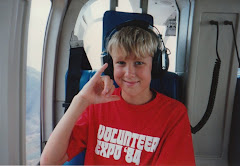
Yesterday in the local coffee shop there was a kid with a helicopter on his t-shirt.
I told him I was a helicopter pilot (ok, that's a stretch, but easier than explaining the larger truth).
Although I couldn't actually take him for a helicopter ride, he did end up wearing my headset and sunglasses, and I taught him how to ask air traffic control for clearance to land.
Here's a picture, I think his name was Laith (Leyth?). He seemed to enjoy pretending to be a helicopter pilot. And for the record, I did too.

Tuesday, August 12, 2008
I can fly a helicopter
I had a great flight today, and I figure I should make a note of it here to counterbalance all my bellyaching about fear and crisis.
Today, for the first time, I managed every segment of the flight, from pick up to set down, without needing help from my instructor. It was sloppy in places, but even if Grant hadn't been there, I still could have taken off, flown around, and come back in one piece.
Not surprisingly, I had another first: As soon as the lesson was over, I wanted to go again.
The best worst idea I've ever had
In my last post, I explained why helicopter flight school scares the shit out of me. There are several more reasons why it's a horrible idea.
First, it's incredibly expensive. Scratch that, it's absurdly expensive. Any half-witted person would take the money and either invest it or buy something useful. I'm spending it on learning a skill that I won't ever use.
Which brings me to number two: It's a useless skill. Obtaining your private helicopter license is like graduating from elementary school; a lot more training (=time and money) is required for true competence.
 Plus, in order to remain competent (and safe), you need to fly frequently. That requires either a job as a pilot or Harrison Ford's bank account. I don't want to be a professional pilot, and I don't see myself having heaps of money anytime in the (near?) future, which makes this whole endeavor, at some point, a dead end.
So, why am I doing it? Well, as I explained to my mother during our conversation, I think I'm learning to fly helicopters precisely because it's so scary and ridiculous. Let me explain.
I fundamentally believe that the only real limits we face in life are self-imposed, usually due to fear, and I like to share that belief with the hope that it will inspire others to move beyond their own self-imposed limits.
 I realized: The benefit I get from engaging in an extravagant, terrifying experience with no apparent practical purpose is manifested through this blog.
In short, as I explained to my Mom, I want this blog to serve as an example. My intention is for it to be an emphatic exclamation: Anything is possible!! If it helps one person pursue a dream, no matter how scary or "ridiculous," then it's all worth it.
To which my Mom, an Episcopal priest with a penchant for speaking in the Christian equivalent of Zen koans, simultaneously puzzling and profound, said:
"You know, the best sermons I've ever heard have generally been those which the preacher, more than anyone else in the room, needed to hear."
Hm. Let me think about that for a bit.
Sunday, August 10, 2008
Yup, I'm still scared
The other day I was talking to my dear Mom about this experience, and I said, "It still scares the shit out of me. Every day, I just don't know if I'm up to it."
She laughed and said, "You need to put that in your blog." And then she said something very profound, but first let me articulate why flying still gets to me.
 My current instructor, Grant, mentioned that when he was a kid, he used to climb trees so high his grandmother would implore him to come down, but he would climb even higher because he loved the heights so much. Future helicopter pilot, that one.
When I was a kid, I would climb to the second branch, look down, and wonder what the hell had possessed me to risk my life.
Sometimes in the helicopter I still look down through a thousand feet of air and feel my insides seize, but for the most part I can handle the heights, which I suppose is progress. However, that irrational fear has been replaced with a rational one.
That is to say, I no longer fear being sucked from of my seatbelt and out the door through some impossible inversion of the laws of physics, but I am more aware of the real danger in flying helicopters.
Helicopter engines fail. I've personally spoken with pilots who have experienced serious engine trouble in mid-flight. I've seen videos of crashes in which pilots with similar trouble failed to perform autorotation, and died as a result. I've also witnessed firsthand the complexity of performing autorotation.
 Every time I watch an instructor fly in autorotation, I'm astounded by their ability to multitask so many things so quickly. I can't even list them all for you, because I don't even know them. But at the very least, the pilot must simultaneously:
I'm not sure how I'm ever going to pull that off. What if my engine fails and I just freeze? What if I'm just practicing engine failure and I freeze?
Plus, although I trust my instructor to successfully manage autorotations, I also know that sometimes instructors don't. It says so right there in the title of Robinson's supplemental safety notice SN-38 for their helicopter, which was issued in direct response to a disturbing trend:

So hell yeah I'm scared. And the more I think about it, the more I realize this fear is only one of several reasons why learning to fly helicopters is the exact wrong thing for me to be doing right now. But I'm still doing it, and I'll explain why (and finish the story about my Mom) in another post.
She laughed and said, "You need to put that in your blog." And then she said something very profound, but first let me articulate why flying still gets to me.
 My current instructor, Grant, mentioned that when he was a kid, he used to climb trees so high his grandmother would implore him to come down, but he would climb even higher because he loved the heights so much. Future helicopter pilot, that one.
When I was a kid, I would climb to the second branch, look down, and wonder what the hell had possessed me to risk my life.
Sometimes in the helicopter I still look down through a thousand feet of air and feel my insides seize, but for the most part I can handle the heights, which I suppose is progress. However, that irrational fear has been replaced with a rational one.
That is to say, I no longer fear being sucked from of my seatbelt and out the door through some impossible inversion of the laws of physics, but I am more aware of the real danger in flying helicopters.
Helicopter engines fail. I've personally spoken with pilots who have experienced serious engine trouble in mid-flight. I've seen videos of crashes in which pilots with similar trouble failed to perform autorotation, and died as a result. I've also witnessed firsthand the complexity of performing autorotation.
 Every time I watch an instructor fly in autorotation, I'm astounded by their ability to multitask so many things so quickly. I can't even list them all for you, because I don't even know them. But at the very least, the pilot must simultaneously:
- monitor rotor RPM on the tachometer gauge
- monitor airspeed on the airspeed gauge
- monitor descent rate on the vertical speed indicator
- identify a nearby landing spot, and then maintain nearly constant visual contact with it (while still watching all the above)
- monitor his own sense of weight (or weightlessness) in his seat
- make constant, precise adjustments to manual controls to keep RPM, airspeed, and descent rate in extremely narrow ranges
- make the required compensatory adjustments to the other manual controls in order to balance any of the above adjustments
- steer to the landing spot
I'm not sure how I'm ever going to pull that off. What if my engine fails and I just freeze? What if I'm just practicing engine failure and I freeze?
Plus, although I trust my instructor to successfully manage autorotations, I also know that sometimes instructors don't. It says so right there in the title of Robinson's supplemental safety notice SN-38 for their helicopter, which was issued in direct response to a disturbing trend:

So hell yeah I'm scared. And the more I think about it, the more I realize this fear is only one of several reasons why learning to fly helicopters is the exact wrong thing for me to be doing right now. But I'm still doing it, and I'll explain why (and finish the story about my Mom) in another post.
Subscribe to:
Posts (Atom)

 Posts

